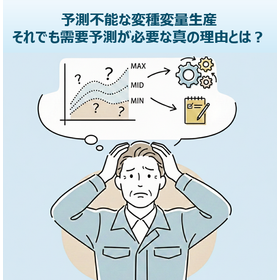
How to deal with inaccurate demand forecasts? Practical knowledge from the food manufacturing industry.
In the difficult-to-read food manufacturing environment, it is common for forecasts to be off. How are companies coping with this?
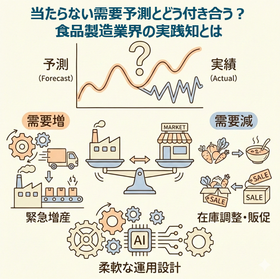
In the food manufacturing industry, demand forecasting is utilized with the premise that it "is not always accurate." Production plans are based on daily sales data, seasonal events, and weather forecasts, but because food has a short shelf life and trends can change rapidly, achieving 100% accuracy is not feasible. As a result, companies position forecasts not as "correct answers" but as "guidelines for decision-making." They are used as a foundation to support on-site judgments regarding raw material procurement, line operation, and personnel allocation, and are flexibly adjusted daily and weekly based on actual performance. So, how do companies recover when forecasts are off? If demand is higher than expected, they increase production through emergency procurement in collaboration with suppliers, switching to other lines, or utilizing external factories. Conversely, if there is leftover inventory, they mitigate stock risks through enhanced promotions, expanding shipping destinations, repurposing, and reducing the production volume for the next cycle. Additionally, there are increasing cases where short-term forecasts are recalculated using AI, and POS data is immediately reflected to quickly restore forecasting accuracy. Ultimately, the key point for the food manufacturing industry in dealing with uncertain demand is the "operational design that incorporates the possibility of being wrong."
- Company:テクノプロ コンサルティング・パートナーズ社 システムソリューション事業部
- Price:Other